$ Home Project Cost Guide
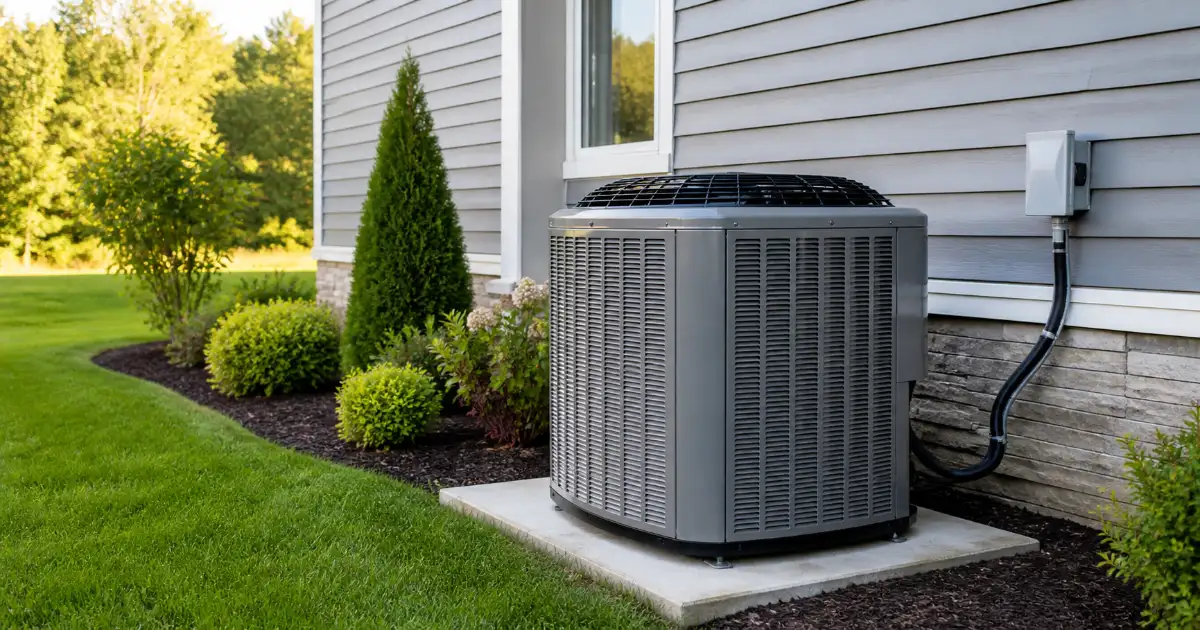
HVAC outdoor condenser unit installed beside a modern American home
HVAC Cost Guide

HVAC replacement cost guide for U.S. homeowners.

Use this page to estimate HVAC replacement costs, compare common system options, and understand the factors that can raise or lower your final quote. This page is designed for planning before requesting in-home contractor estimates.

Last updated: April 2026

HVAC replacement calculator

Enter a few project details to generate a simple planning estimate.

This tool is for planning only. Final pricing can change based on load calculations, brand selection, ductwork condition, code requirements, and contractor scope.

Want to understand how these estimates are built? See our methodology.

Quick HVAC replacement cost overview

These planning ranges give you a practical starting point before collecting contractor quotes.

Lower range
$6,000–$9,000

Smaller homes or simpler replacement scope with standard equipment

Typical mid-range
$9,000–$15,000

Common full-system or higher-quality replacement range

Higher range
$15,000+

Complex installs, premium efficiency, or major duct/electrical work

Typical planning rate
$4.00–$8.00+ / sq ft

Varies by system type, home size, and installation scope

What affects HVAC replacement cost

  • System type and equipment efficiency rating
  • Home size and required system capacity
  • Whether existing ductwork can be reused
  • Number of zones or indoor units
  • Electrical upgrades or code-related corrections
  • Installation difficulty and equipment access
  • Regional labor rates and seasonal demand
  • Thermostat, filtration, and accessory upgrades

HVAC replacement cost by project scope

Budget replacement

Usually involves standard-efficiency equipment, limited extras, and a simpler installation scope where most of the existing setup remains usable.

Mid-range replacement

Often includes better equipment quality, moderate efficiency upgrades, thermostat improvements, and standard contractor scope.

Premium replacement

May include high-efficiency systems, better filtration, zoning features, upgraded controls, or more extensive installation work.

Complex replacement

Can involve major duct changes, electrical work, difficult access, multiple zones, or installation corrections needed for code or performance.

HVAC replacement cost by system type

System choice affects both upfront installation cost and long-term operating expectations.

Central Air Conditioner

Mid-range 12–18 years

A common cooling upgrade for homes with existing ductwork, especially when the main goal is replacing aging AC equipment.

Heat Pump

Mid to high 10–15 years

Provides both heating and cooling and may be attractive where year-round efficiency matters.

Gas Furnace + AC Split System

Mid to high 15–20 years

A common full-system replacement option when both heating and cooling equipment need to be updated together.

Ductless Mini Split

Varies by zones 12–20 years

Useful for homes without ducts or for projects that need more targeted, zone-based comfort control.

HVAC replacement cost comparison by system type

Option Low Range Mid Range High Range Lifespan Best For
Central AC Only $4,500 $6,500 $9,000 12–18 yrs Cooling-only replacement
Heat Pump $5,500 $8,200 $12,000 10–15 yrs Year-round efficiency
Gas Furnace + AC $7,000 $9,800 $15,000 15–20 yrs Full system replacement
Ductless Mini Split $3,000 $7,200 $14,000 12–20 yrs No ductwork available

Ranges are approximate and intended for planning only. Actual quotes may differ based on project scope and local market.

HVAC replacement cost breakdown

Understanding where your money goes can help you make better budgeting decisions and compare contractor quotes more effectively.

Equipment (unit, coils, components) 45%
$4,050–$6,750
Labor (installation, connections, testing) 30%
$2,700–$4,500
Ductwork modifications 10%
$900–$1,500
Thermostat & accessories 8%
$720–$1,200
Permits & electrical 7%
$630–$1,050

Based on a typical mid-range HVAC replacement ($9,000–$15,000). Percentages vary by system type.

Average HVAC replacement cost by city

Costs vary by location due to labor rates, permit requirements, and market demand. These estimates adjust national averages for each metro area.

New York, NY
$7,680 – $19,200
Avg: $13,440
High
Los Angeles, CA
$7,320 – $18,300
Avg: $12,810
High
Chicago, IL
$6,720 – $16,800
Avg: $11,760
Above avg
Houston, TX
$5,820 – $14,550
Avg: $10,185
Average
Phoenix, AZ
$5,760 – $14,400
Avg: $10,080
Average
Philadelphia, PA
$6,480 – $16,200
Avg: $11,340
Above avg
Dallas, TX
$5,880 – $14,700
Avg: $10,290
Average
Atlanta, GA
$5,940 – $14,850
Avg: $10,395
Average
Miami, FL
$6,900 – $17,250
Avg: $12,075
High
Denver, CO
$6,600 – $16,500
Avg: $11,550
Above avg

City estimates are based on regional cost adjustments and are intended for planning only.

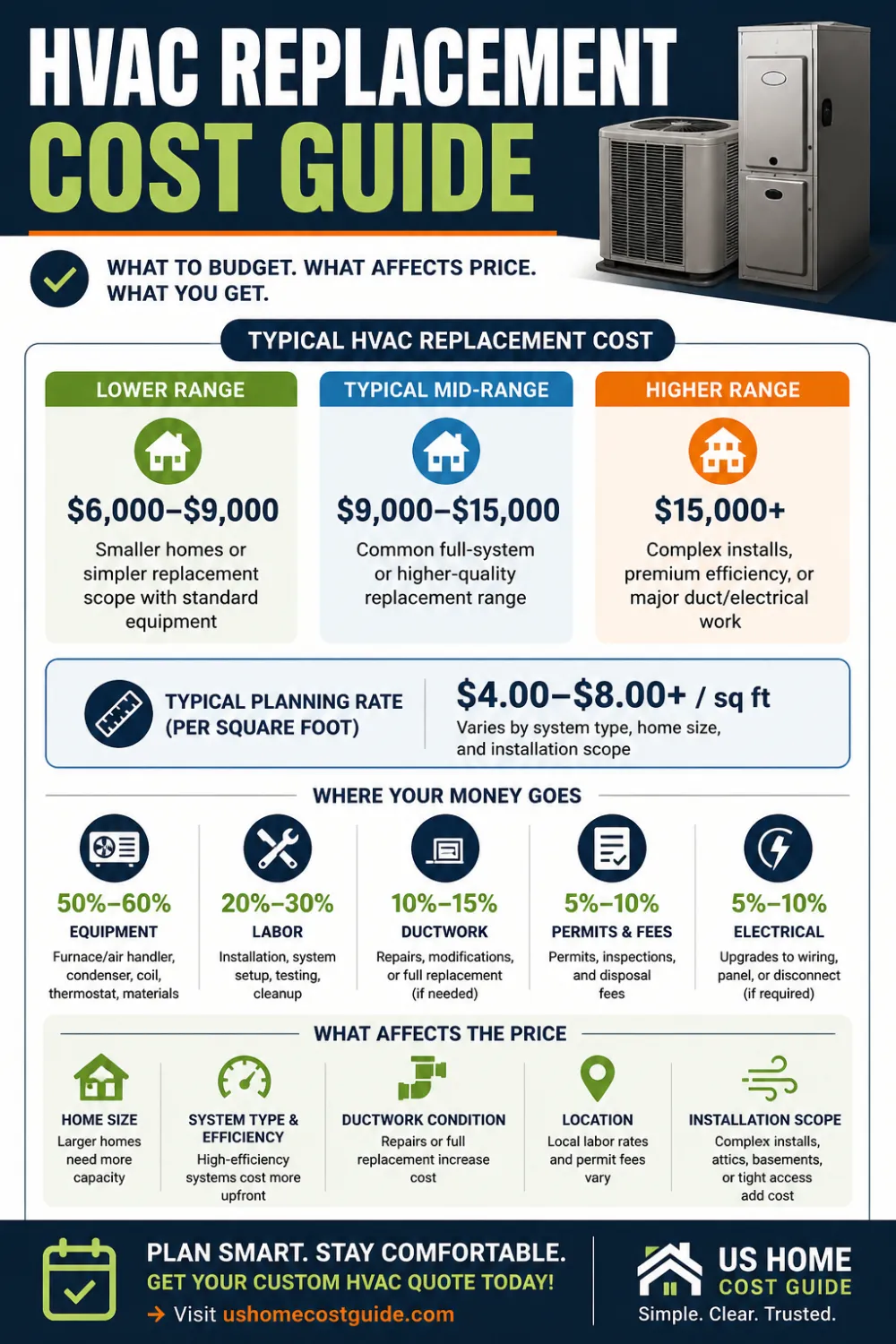
📊 Visual Cost Summary

HVAC Replacement Cost Guide — visual cost overview

This visual cost summary covers the main factors that affect HVAC replacement costs, including system type, efficiency rating, ductwork, and installation complexity.

Lower range $6,000–$9,000 Budget projects
Mid-range $9,000–$15,000 Most common
Higher range $15,000+ Premium scope

Planning a project? Use our calculator for a personalized estimate based on your home.

Get Your Estimate →

What can increase your final HVAC quote?

  • Major ductwork replacement or redesign
  • Electrical upgrades or code-related corrections
  • Higher-efficiency equipment or premium accessories
  • Difficult installation access or space constraints
  • Zoning features, multiple indoor units, or specialty controls
  • Seasonal demand or tighter contractor availability in your area

Repair vs. replace: which makes more sense?

Repair may make sense when

  • The system is relatively young
  • The repair is isolated and not repeated often
  • Major components like ductwork and electrical setup are still in good shape

Replacement may make more sense when

  • The system is aging and repairs are becoming more frequent
  • Energy performance is poor and utility costs are rising
  • Multiple expensive components are failing at the same time

How to compare HVAC quotes

  • Ask whether the quote includes permits, thermostat, disposal, and startup/testing.
  • Compare labor, equipment, accessories, and code-related items separately.
  • Confirm whether ductwork changes are included or only listed as an allowance.
  • Check the efficiency rating and exact equipment model, not just a general description.
  • Ask what warranty applies to equipment versus workmanship.
  • Avoid comparing quotes only by total price; scope differences often explain big price gaps.

Frequently asked questions

How much does HVAC replacement cost?

HVAC replacement costs depend on home size, system type, efficiency level, ductwork condition, and regional labor rates. This page provides a planning estimate rather than a final contractor quote.

What raises HVAC installation cost the most?

The biggest cost drivers are system type, capacity, efficiency upgrades, ductwork changes, electrical work, code corrections, and installation complexity.

How much does HVAC replacement cost per square foot?

Planning ranges often fall within a moderate per-square-foot range, but actual cost depends more on system type and project scope than square footage alone.

Is a heat pump cheaper than a furnace and AC system?

Sometimes, but not always. Climate, existing infrastructure, contractor pricing, and equipment selection all affect which option ends up costing less.

Should ductwork be replaced at the same time?

Not always. If the ductwork is in good condition and correctly sized, it may be reusable. If it is leaking, undersized, damaged, or poorly laid out, replacement or modification may be worth considering.

Does higher efficiency always mean better value?

Not necessarily. Higher-efficiency equipment can cost more upfront, so the better value depends on climate, energy use, utility rates, and how long you plan to keep the home.

What should be included in an HVAC quote?

A good quote should clearly list equipment, labor, thermostat, disposal, ductwork assumptions, permit handling if applicable, electrical work, warranty, and any code-related corrections.

How accurate is the HVAC cost calculator?

It provides a broad planning estimate based on common project factors. Final quotes can change after load calculations, duct inspection, equipment selection, and on-site evaluation.

Methodology

The estimates on this page are intended for planning only. They are based on common project variables such as system type, home size, efficiency level, installation difficulty, ductwork condition, and regional labor adjustment.

Actual contractor pricing may differ after load calculations, equipment selection, duct inspection, permit review, electrical evaluation, and on-site scope confirmation.

HP
Home Project Cost Guide Editorial Team Research & Cost Analysis

Our editorial team researches and compiles home improvement cost data from contractor pricing surveys, manufacturer specifications, permit databases, and regional labor rate benchmarks to create practical planning estimates for U.S. homeowners.

✓ Published 200+ cost guides and calculators✓ Covers 25 U.S. states with localized pricing✓ Data sourced from contractor and industry benchmarks
Last reviewed: April 2026