$ Home Project Cost Guide
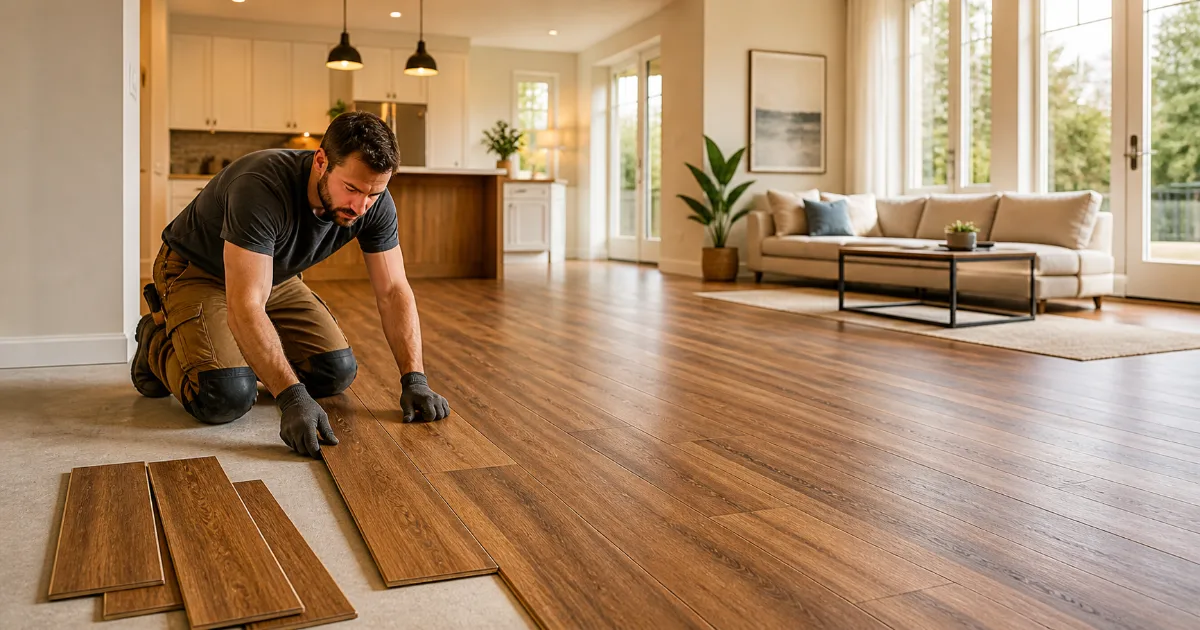
Hardwood flooring installation in a bright modern living space
Flooring Cost Guide

Flooring installation cost guide for U.S. homeowners.

Use this page to estimate flooring installation costs, compare common flooring materials, and understand the factors that can raise or lower your final quote. This page is designed for planning before requesting contractor estimates.

Last updated: June 2026

Flooring installation calculator

Enter a few project details to generate a simple planning estimate.

This tool is for planning only. Final pricing can change based on room layout, product brand, moisture conditions, stairs, trim scope, and local labor rates.

What to know before you start a flooring installation

Installing new flooring can completely transform a home, but the key to a beautiful, long-lasting floor is the preparation work underneath. The subfloor must be flat, clean, and structurally sound. Any dips or crowns in a wooden subfloor or concrete slab will cause hardwood to squeak, vinyl planks to separate, and tile to crack. Subfloor preparation—which may include sanding plywood joints, screwing down loose panels, or pouring self-leveling underlayment—typically accounts for 15% to 30% of professional installation labor. Ensure your contractor tests the flat tolerance (usually 3/16 inch over a 10-foot radius) before laying materials.

Another critical step that is frequently skipped is material acclimation. Hardwood, laminate, and luxury vinyl flooring are organic or composite materials that expand and contract based on indoor temperature and relative humidity. Before installation, the flooring materials must be stored inside the climate-controlled rooms where they will be installed for 3 to 7 days. Installing wood or vinyl straight out of a cold delivery truck into a warm room will lead to severe warping, cupping, or gap separation within months.

Finally, select the correct underlayment for your specific material and foundation. For concrete slab installations, a 6-mil polyethylene vapor barrier is essential under laminate or floating engineered hardwood to block ground moisture. For second-story installations, invest in high-quality sound-dampening underlayment to reduce footstep transmission, especially in condominium or townhouse settings.

What's changed in 2026?

In 2026, Luxury Vinyl Plank (LVP) continues to lead the residential flooring market, now accounting for nearly half of all new flooring installations. LVP has improved its visual embossing and texture to replicate real wood grains almost indistinguishably, while retaining its waterproof durability. Engineered hardwood remains the top choice for luxury projects, with wide-plank (7 to 9 inches) configurations in lighter oak tones being highly requested. Traditional wall-to-wall carpeting continues to decline, now primarily installed in bedrooms, while large-format porcelain tiles (24x48 inches) are standard for modern bathroom and entryway renovations.

Want to understand how these estimates are built? See our methodology.

Quick flooring installation cost overview

These planning ranges give you a practical starting point before collecting contractor quotes.

Lower range
$3,500–$7,000

Smaller projects or more budget-friendly flooring materials

Typical mid-range
$7,000–$15,000

A common planning range for many whole-room or larger flooring projects

Higher range
$15,000+

Premium materials, subfloor repair, or more complex installation scope

Typical planning rate
$5.00–$14.00+ / sq ft

Varies by material, prep work, removal scope, and labor market

What affects flooring installation cost

  • Total square footage of the installation area
  • Flooring material type and product quality
  • Subfloor condition and leveling requirements
  • Removal and disposal of old flooring
  • Baseboards, trim work, and transitions
  • Room layout, stairs, cuts, and installation complexity
  • Moisture barriers, underlayment, and adhesives
  • Regional labor rates and contractor demand

Flooring installation cost by project scope

Budget installation

Usually involves simpler room layouts, more cost-conscious materials, and limited prep or finishing work.

Mid-range installation

Often includes better material quality, standard prep, underlayment, transitions, and moderate labor scope.

Premium installation

May include hardwood, tile, upgraded underlayment, more detailed cuts, and a higher-quality installation finish.

Complex installation

Can involve stairs, difficult layouts, moisture issues, heavy subfloor correction, or significant demolition and trim work.

Flooring installation cost by material

Material choice influences not only product price but also prep requirements, labor time, and long-term maintenance expectations.

Laminate Flooring

Lower budget range 10–20 years

Often chosen for affordability and appearance, especially in spaces where budget matters more than long-term refinishing potential.

Luxury Vinyl Plank (LVP)

Budget to mid-range 10–25 years

Popular for water resistance, easy maintenance, and style variety, making it a common choice for many modern remodels.

Hardwood Flooring

Mid to high 20–100+ years

A premium flooring option that can add long-term value, though material and labor costs are often higher than resilient flooring.

Tile Flooring

Mid to high 20–50+ years

Durable and often preferred in moisture-prone areas, but installation cost can rise because of prep work and tile labor.

Flooring installation cost comparison by material

Option Low Range Mid Range High Range Lifespan Best For
Laminate $3.50 / sq ft $5.50 / sq ft $8.00 / sq ft 10–20 yrs Budget-friendly update
Luxury Vinyl (LVP) $4.00 / sq ft $6.75 / sq ft $10.00 / sq ft 10–25 yrs Water-resistant areas
Hardwood $8.00 / sq ft $11.50 / sq ft $18.00 / sq ft 20–100+ yrs Long-term value
Tile $8.00 / sq ft $12.50 / sq ft $20.00 / sq ft 20–50+ yrs Wet areas & durability

Ranges are approximate and intended for planning only. Actual quotes may differ based on project scope and local market.

Flooring installation cost breakdown

Understanding where your money goes can help you make better budgeting decisions and compare contractor quotes more effectively.

Materials (flooring, underlayment, adhesives) 45%
$3,150–$6,750
Labor (installation, cutting, finishing) 30%
$2,100–$4,500
Subfloor prep & leveling 10%
$700–$1,500
Removal & disposal 10%
$700–$1,500
Trim, transitions & misc. 5%
$350–$750

Based on a typical mid-range flooring project ($7,000–$15,000). Percentages vary by material.

Average flooring installation cost by city

Costs vary by location due to labor rates, permit requirements, and market demand. These estimates adjust national averages for each metro area.

New York, NY
$4,480 – $19,200
Avg: $12,800
High
Los Angeles, CA
$4,270 – $18,300
Avg: $12,200
High
Chicago, IL
$3,920 – $16,800
Avg: $11,200
Above avg
Houston, TX
$3,395 – $14,550
Avg: $9,700
Average
Phoenix, AZ
$3,360 – $14,400
Avg: $9,600
Average
Philadelphia, PA
$3,780 – $16,200
Avg: $10,800
Above avg
Dallas, TX
$3,430 – $14,700
Avg: $9,800
Average
Atlanta, GA
$3,465 – $14,850
Avg: $9,900
Average
Miami, FL
$4,025 – $17,250
Avg: $11,500
High
Denver, CO
$3,850 – $16,500
Avg: $11,000
Above avg

City estimates are based on regional cost adjustments and are intended for planning only.

📊 Visual Cost Summary

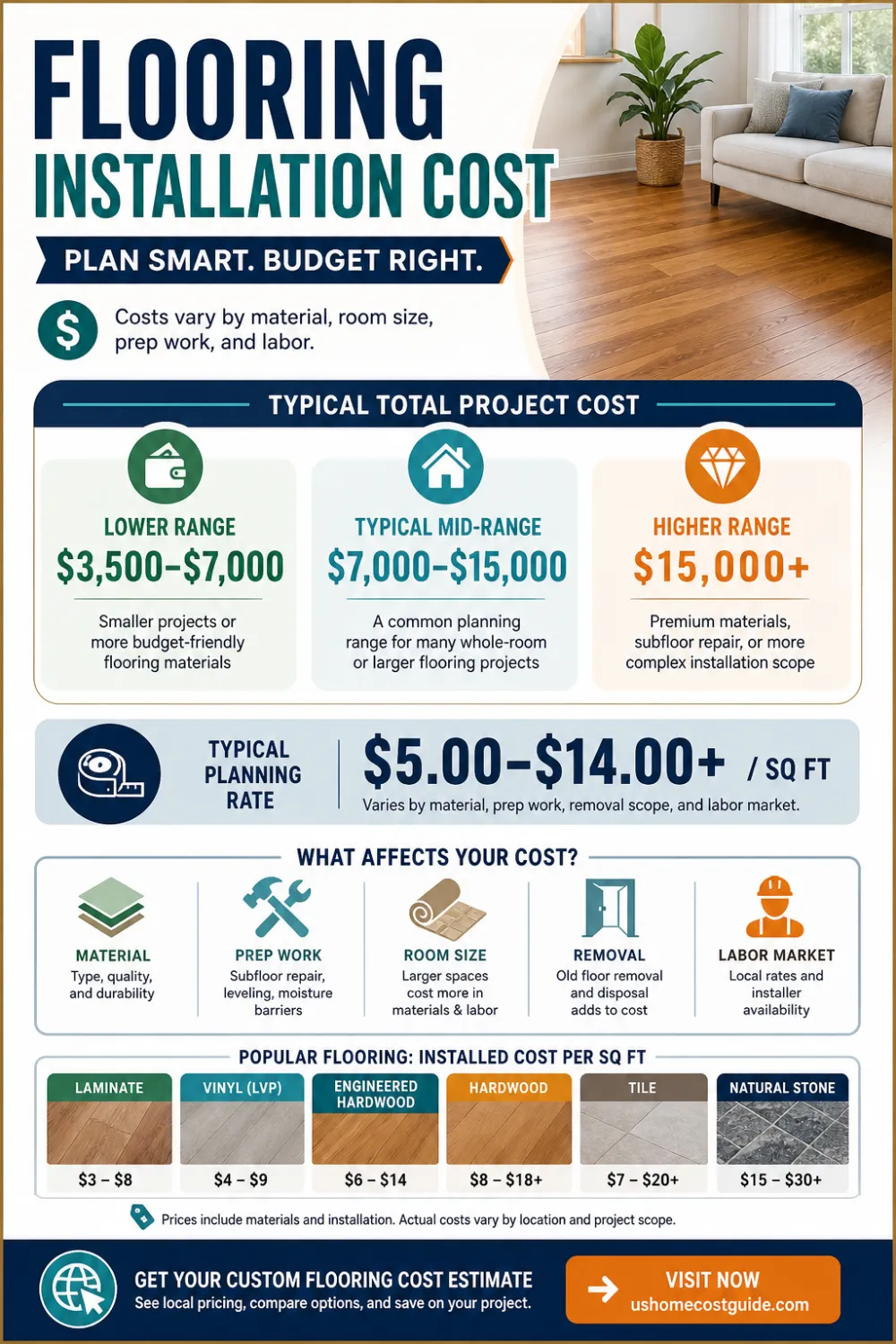
Flooring Installation Cost Guide — visual cost overview

This visual cost summary covers the main factors that affect flooring installation costs, including material type, square footage, subfloor condition, and removal scope.

Lower range $3,500–$7,000 Budget projects
Mid-range $7,000–$15,000 Most common
Higher range $15,000+ Premium scope

Planning a project? Use our calculator for a personalized estimate based on your home.

Get Your Estimate →

What can increase your final flooring quote?

  • Subfloor damage, moisture issues, or heavier leveling needs
  • Stairs, detailed cuts, closets, and more complicated room layouts
  • Premium materials such as hardwood or tile
  • Removal of old flooring, adhesives, or underlayment layers
  • Transition pieces, trim work, and finish carpentry
  • Better underlayment, soundproofing, or moisture-barrier upgrades

Simpler install vs. larger-scope upgrade

A simpler install may make sense when

  • The existing subfloor is in good condition
  • The room layout is straightforward
  • You are choosing a product with simpler installation requirements

A larger-scope project may make more sense when

  • The old flooring is damaged or uneven
  • Moisture, squeaks, or soft spots need correction first
  • You want a longer-lasting upgrade with better materials and finish quality

How to compare flooring installation quotes

  • Ask whether removal, disposal, underlayment, transitions, and trim are included.
  • Compare material grade, wear layer, finish type, and installation method carefully.
  • Check whether subfloor prep is included or only estimated as an allowance.
  • Ask what happens if moisture problems or leveling issues are discovered after removal.
  • Review stairs, closets, and detailed edge work separately if they are part of the project.
  • Avoid comparing quotes only by total price; material quality and prep scope often explain big differences.

Frequently asked questions

How much does flooring installation cost?

Flooring installation costs vary by square footage, flooring material, labor rates, subfloor condition, and removal work. This page provides a planning estimate rather than a contractor quote.

What makes flooring installation more expensive?

Material choice, subfloor repair, demolition of old flooring, room complexity, stairs, trim work, and moisture prep are major cost drivers.

How much does flooring installation cost per square foot?

Planning ranges often vary from the lower single digits into the low teens or more per square foot depending on material type and installation scope.

Is luxury vinyl plank cheaper than hardwood?

In many cases, yes. LVP is often less expensive upfront than hardwood, though exact pricing depends on product quality, prep needs, and labor.

Should old flooring be removed before new flooring is installed?

Often yes, but not always. Some products can go over certain existing floors in the right conditions, though removal is often the cleaner long-term approach.

Does subfloor condition matter a lot?

Yes. Uneven or damaged subfloors can significantly raise project cost because leveling and repair often add labor and materials.

What should be included in a flooring quote?

A strong quote should clearly list material, labor, underlayment, removal, disposal, transitions, trim assumptions, subfloor prep, and cleanup.

How accurate is the flooring cost calculator?

It provides a broad planning estimate based on common project variables. Final quotes can change depending on subfloor condition, product selection, stairs, moisture issues, and local labor pricing.

Methodology

The estimates on this page are intended for planning only. They are based on common project variables such as floor area, material type, installation complexity, subfloor preparation, removal scope, and regional labor adjustment.

Actual contractor pricing may differ after site inspection, product selection, moisture evaluation, subfloor assessment, stair scope review, and final installation details are confirmed.
HP
Home Project Cost Guide Editorial Team Research & Cost Analysis

Our editorial team researches and compiles home improvement cost data from contractor pricing surveys, manufacturer specifications, permit databases, and regional labor rate benchmarks to create practical planning estimates for U.S. homeowners.

✓ Published 200+ cost guides and calculators✓ Covers 25 U.S. states with localized pricing✓ Data sourced from contractor and industry benchmarks
Last reviewed: June 2026