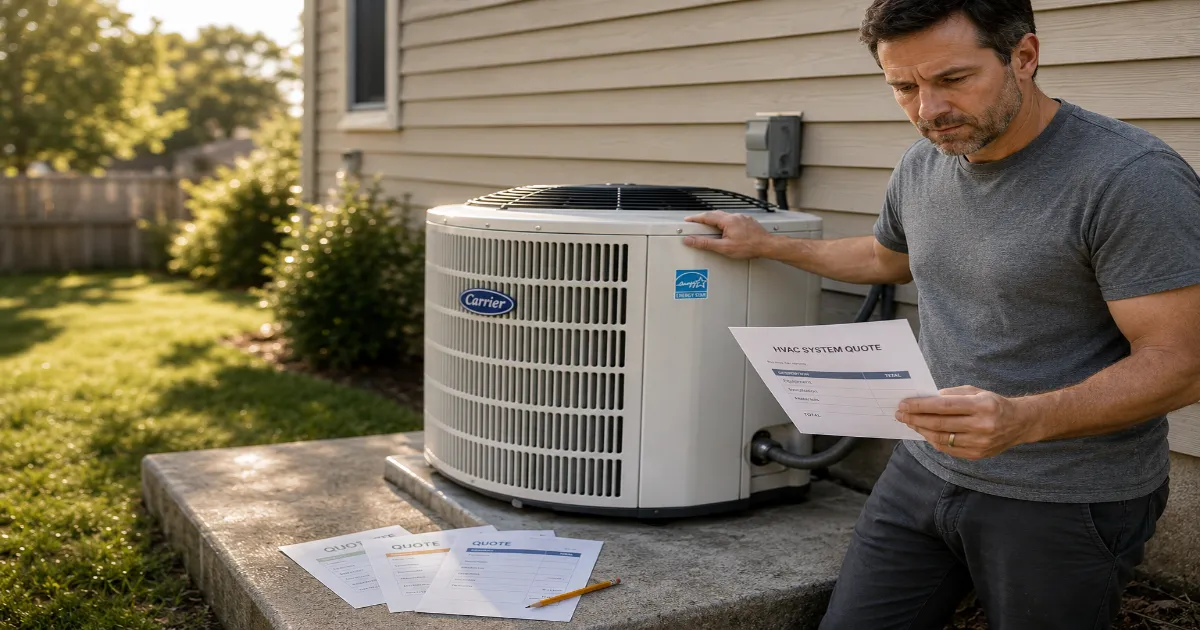
A homeowner I spoke with last month had three HVAC quotes spread out on her kitchen table. The numbers were $14,800, $18,500, and **$26,400**. Same house. Same square footage. Same Carrier brand equipment. The highest quote was nearly double the lowest, and the technician who delivered it spent forty-five minutes explaining why his price was actually the "best value."
Why HVAC quotes vary so dramatically
This is the HVAC industry in 2026. The gap between quotes for identical work has never been wider, and the reason is simple: most homeowners only get one or two quotes, and contractors have figured out that the homeowner who only gets one quote will probably pay whatever number is written down.
Here's what's actually inflating those numbers, and how to spot it.
The Oversizing Trap
This is the single most common form of HVAC overcharging in America, and almost nobody catches it. The technician walks through your home, asks how many square feet it is, and quotes you a **4-ton system** when your home actually needs a 2.5-ton system.
The oversized unit costs $1,500–$3,000 more in equipment, requires beefier ductwork (more labor), and — here's the cruel part — actually performs *worse*. It cycles on and off too quickly, never running long enough to dehumidify properly, leaving your home cold but clammy. It also wears out faster from the constant cycling.
The right way to size an HVAC system is called a **Manual J load calculation**, which factors in insulation, window orientation, ceiling height, and air leakage. A real contractor will spend 60–90 minutes doing this. A contractor who quotes you in 15 minutes based on square footage alone is almost certainly oversizing.
If your quote doesn't reference Manual J, ask for one. If they refuse, get a different contractor.
The "While We're In There" Upsell Stack
HVAC quotes love to bundle in extras that sound essential but rarely are. Here are the ones to watch:
**UV light air purifiers** — $600 to $1,200 added. Marketed as essential for air quality. In reality, they help slightly with mold growth in the air handler itself but do almost nothing for the air you actually breathe. Skip it unless you have specific mold issues.
**Whole-home humidifiers** — $800 to $1,500 added. Genuinely useful in cold dry climates (Minnesota, Colorado). Mostly useless in humid southern climates. Most quotes include them by default regardless of region.
**Smart zoning systems** — $2,500 to $5,000 added. Excellent for multi-story homes with hot and cold spots. Wasteful for single-story homes under 1,800 sq ft. Many contractors push zoning on homes that don't need it.
**Premium air filters with MERV 16 ratings** — $400 to $700 in extra system modifications. Most homes do fine with standard MERV 8–11 filters. Higher ratings can actually restrict airflow and damage the system if the unit wasn't designed for them.
If your quote has three or more of these add-ons, you're looking at $4,000–$8,000 of optional spending presented as standard.
The Labor Inflation Game
HVAC labor has genuinely gone up. Skilled technicians now bill at $95–$165 per hour in most U.S. markets. But the *amount of labor* being quoted is where the trick happens.
A standard full HVAC replacement on an existing system — same location, same ductwork — takes a skilled two-person crew about **10–14 hours**. That's roughly $1,800–$3,600 in honest labor. When you see "Labor: $7,500" on a quote with no breakdown, something is wrong.
The fix is simple: ask for labor hours to be itemized. *"How many crew-hours is this job, and at what rate?"* Honest contractors answer immediately. Dishonest ones get vague.
The Brand Markup Most Homeowners Don't Know About
The dirty secret of the HVAC industry is that the major brands — Carrier, Trane, Lennox, Rheem, Goodman — are largely manufactured by the same parent companies. Carrier and Bryant are the same. Trane and American Standard are the same. Rheem and Ruud are the same. The equipment is nearly identical; the branding is not.
A "premium" Trane system might cost $2,500 more than the identical American Standard system in the same SEER rating. A Carrier quote might come in $1,800 higher than a Bryant quote for mechanically equivalent equipment. If a contractor pushes hard for one specific premium brand, ask what the equivalent "value" brand from the same parent company would cost.
The Financing Markup Hidden In Plain Sight
Many HVAC companies offer "zero percent financing." It's almost never actually zero percent. The financing fees — typically 8–12% — are baked into the equipment price. If you ask for the cash price, you'll often find it's **$1,500–$3,500 lower** than the financed price.
This isn't illegal. It's standard practice. But it means that if you have the cash to pay outright, you should always ask: *"What's your cash price versus the financed price?"*
A Realistic 2026 HVAC Replacement Cost
For an average 2,000 sq ft American home in 2026, a full HVAC replacement should land in these ranges:
Standard efficiency (14–16 SEER) split system: **$8,500 – $13,000.**
High efficiency (17–20 SEER) split system: **$12,000 – $17,500.**
Heat pump system with electric backup: **$13,500 – $19,500.**
Full system with new ductwork: add **$3,500 – $7,500.**
If your quote is significantly higher than these ranges without a clear technical reason (unusual home layout, premium zoning needs, structural complications), the markup is probably the explanation — not the equipment.
The Three-Quote Rule, With a Twist
Everyone says "get three quotes." Here's the twist that makes it actually work: **don't tell quote #2 and #3 what quote #1 came in at**. The moment a contractor knows the competing number, they'll price just under it instead of pricing the job honestly. Get blind quotes, then compare.
Also — and this matters — get one of those quotes from an independent local contractor with no big-name affiliation. The national chains carry overhead the small operators don't. The work quality is often identical.
Get at least three quotes and compare scope, not just price. Ensure each includes the same equipment tier, installation scope, permits, and warranty. A quote 30%+ above the average of three bids may be inflated.
What is Manual J and why does it matter?
Manual J is the industry-standard method for calculating your home's heating and cooling load. It determines the correct system size. Without it, contractors often oversize systems — costing you more upfront and reducing efficiency.
Is a higher SEER rating always worth the cost?
Not always. Higher SEER systems cost more upfront but save on energy bills. In moderate climates, the payback period for premium efficiency may exceed 10 years. In hot climates like the Southeast, high-SEER systems often pay for themselves within 5–7 years.
Our editorial team researches and compiles home improvement cost data from contractor pricing surveys, manufacturer specifications, permit databases, and regional labor rate benchmarks to create practical planning estimates for U.S. homeowners.
✓ Published 200+ cost guides and calculators✓ Covers 25 U.S. states with localized pricing✓ Data sourced from contractor and industry benchmarks
Last reviewed: 2026-06-11
Related articles
Continue exploring home improvement topics and cost-saving strategies.
Kitchen
How to Save Money on Your Kitchen Remodel in 2026
Discover practical strategies to cut kitchen renovation costs without sacrificing quality — from keeping your layout to choosing smart material alternatives.