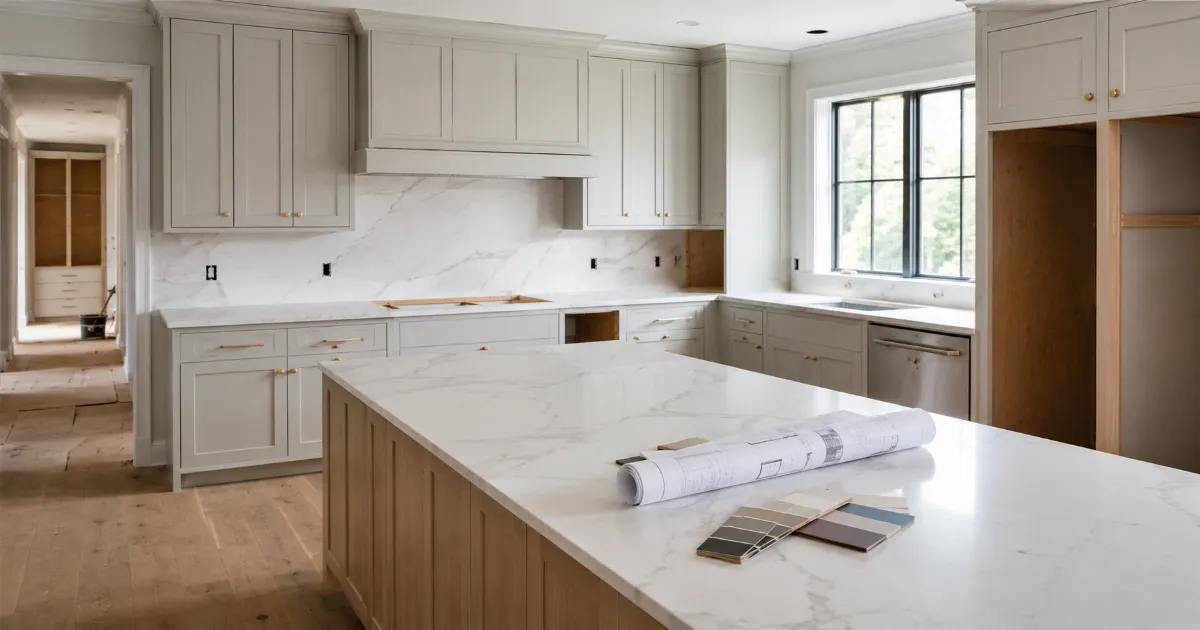
There's a moment, about three weeks into a kitchen remodel, when most homeowners experience the same sinking realization: the final cost is going to be 25–40% higher than the contract said. It's not a coincidence. It's not bad luck. It's how the kitchen remodel industry has quietly worked for decades.
Why kitchen quotes don't match final bills
The trap isn't usually in the headline number. It's in the dozens of small, technical-sounding line items that get added one by one as the project unfolds — each one perfectly reasonable on its own, each one impossible to refuse once demolition has started.
The "Allowance" Game
This is the single biggest source of overspending in American kitchen remodels. Your initial quote includes an "allowance" for things like cabinets ($8,000), countertops ($3,500), appliances ($4,000), and flooring ($2,500). It looks itemized. It looks transparent.
Here's what nobody tells you: those allowances are intentionally set at the **lowest realistic price**, knowing that almost no homeowner ends up choosing the cheapest option. The moment you walk into the cabinet showroom and see what $8,000 actually buys, you upgrade — and that upgrade cost flows straight onto your final invoice, with the contractor's markup attached.
A homeowner I spoke with last year had an $11,000 cabinet allowance. By the time she'd selected what she actually wanted — soft-close drawers, custom paint, a built-in trash pullout — the cabinet bill was $19,400. Nothing illegal happened. She just discovered, halfway through the project, that the "allowance" was a starting line, not a target.
Electrical Surprises That Hit Mid-Project
Modern kitchens demand more power than older homes can deliver. The moment your contractor opens the walls, there's a strong chance they'll find:
A 100-amp panel that needs an upgrade to 200 amps — $2,500 to $4,500. Outlets that don't meet current code spacing — $400 to $900 to bring up to standard. A circuit shared between the microwave and the dishwasher that has to be split — $300 to $600. Old aluminum wiring (common in homes built 1965–1975) that needs partial replacement — $1,500 to $5,000.
None of these are scams. They're real code requirements. But almost none of them show up in the initial quote, because they can't be confirmed until demolition begins.
Plumbing You Can't See Until It's Too Late
Same story, different room. Cast iron drain pipes in homes from before 1985 are often near the end of their lives. The moment they're exposed during a remodel, your inspector — and your conscience — won't let you bury them again. Replacing a kitchen drain stack runs $1,200–$3,500. Replacing the water supply lines while the walls are open adds another $800–$2,000. It's the smart move financially, but it's a real bill nobody mentioned at the showroom.
The Appliance Trap
Showroom designers love to specify high-end appliances because they look incredible in 3D renderings. What they don't always mention: a 36" gas range with a proper hood adds a 6-inch makeup air requirement that may not exist in your current ventilation. A built-in refrigerator needs precise cabinetry depth that off-the-shelf cabinets won't accommodate. A pot filler over the range needs a water line run through walls that weren't planned for plumbing.
Each "small" upgrade triggers a chain reaction of secondary costs that can easily add **$2,000–$6,000** to the final number.
The Drywall and Paint Line Most Quotes Leave Out
Here's a fun one. Many kitchen remodel quotes assume the existing walls are in good condition and only need a coat of paint. After cabinets come down, you'll see drywall damage, old wallpaper glue, anchors, and patches that look terrible under fresh kitchen lighting. Skim-coating and repainting an entire kitchen typically adds $1,200–$2,800 — a line that often appears as a "change order" two weeks in.
How to Protect Yourself
The single most effective thing you can do is **ask for the contractor's complete change-order history from their last three kitchens**. A confident, honest contractor will share it without flinching. You'll see exactly what categories of surprise costs tend to show up. You'll also see whether their projects routinely come in 5% over budget (acceptable) or 35% over (a warning sign).
The second move: ask for allowances to be set at *realistic* levels, not minimum levels. A contractor who's worked with you on real numbers up front is much harder to surprise later.
The third: keep a written contingency. **20% on top of the signed contract.** If you don't need it, great — you finish under budget. If you do, you're not making panicked decisions with a hole in your floor and no plumbing.
What is the average allowance overrun in a kitchen remodel?
Many homeowners exceed initial material allowances by 20% to 50% because base quotes assume entry-level fixtures, whereas buyers typically prefer mid-to-high-end options.
Should I handle kitchen demolition myself to save money?
Demolition can save you $1,000–$2,500, but be careful with wiring, gas, and plumbing. Leave any active line disconnects to licensed professionals.
Our editorial team researches and compiles home improvement cost data from contractor pricing surveys, manufacturer specifications, permit databases, and regional labor rate benchmarks to create practical planning estimates for U.S. homeowners.
✓ Published 200+ cost guides and calculators✓ Covers 25 U.S. states with localized pricing✓ Data sourced from contractor and industry benchmarks
Last reviewed: 2026-06-14
Related articles
Continue exploring home improvement topics and cost-saving strategies.
Kitchen
How to Save Money on Your Kitchen Remodel in 2026
Discover practical strategies to cut kitchen renovation costs without sacrificing quality — from keeping your layout to choosing smart material alternatives.