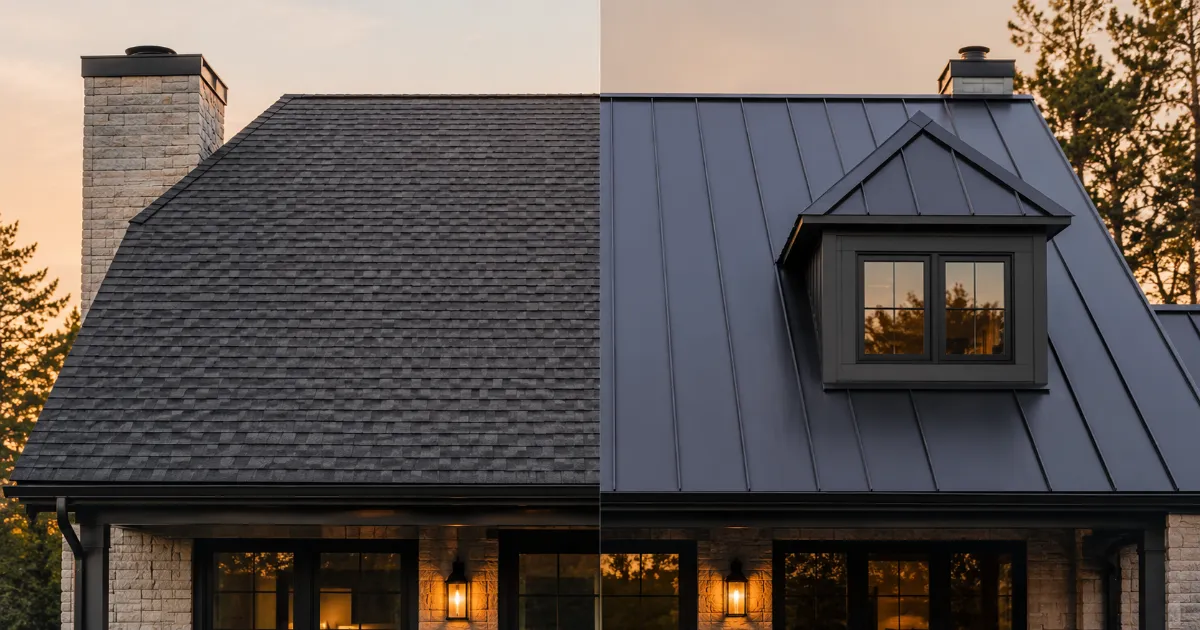
There's a debate happening in driveways and kitchens across America right now. The contractor just left, the asphalt quote is sitting on the counter at $14,000, and somewhere in the conversation he mentioned that a metal roof would run "around $32,000 but last forever." And now you're staring at those numbers wondering which one actually makes financial sense.
The Asphalt vs Metal Roofing Decision
I've watched this exact decision play out hundreds of times, and the honest answer is: it depends entirely on how long you plan to own the house. The math is unambiguous once you stretch it across enough years — but the right answer for a 35-year-old buying their forever home is different from the right answer for a 62-year-old planning to downsize in eight years.
Let's actually do the math.
The Upfront Cost Reality
For an average 2,000 sq ft American roof in 2026, here's what you're really looking at:
Architectural asphalt shingles run **$9,500 to $15,500** installed. This is the default choice — it's what 75% of American homes have, what most contractors install daily, and what insurance companies have priced their policies around.
Standing-seam metal runs **$24,000 to $42,000** installed, with most quality installs landing around $30,000–$35,000. Stone-coated steel and aluminum shingle options sit in between at $18,000–$28,000.
So you're looking at a premium of roughly **$15,000 to $22,000** to go metal. That's a serious gap. The question is whether the next 30 years pay it back.
The Lifespan Difference Nobody Argues About
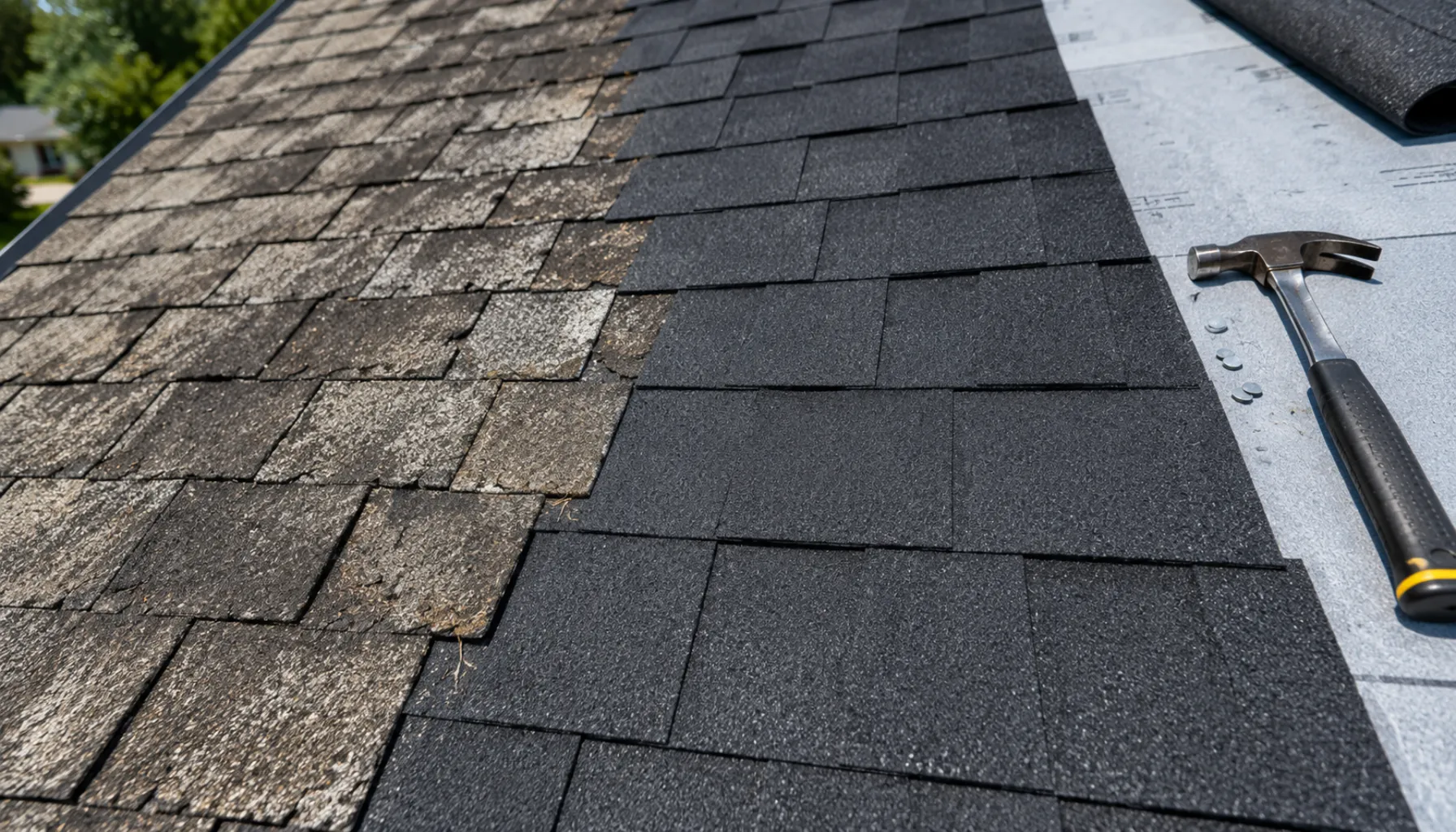
This is the one part of the debate where there's no real disagreement. Quality architectural asphalt shingles last **20–25 years** in moderate climates, less in extreme heat or storm-prone regions. Standing-seam metal lasts **45–70 years**, and many of the metal roofs installed in the 1970s are still going strong today.
In practical terms: if you install asphalt at age 40, you'll likely replace it at age 62 or so. If you install metal at age 40, you'll never replace it again.
The 30-Year Math
Here's where it gets interesting. Let's run a realistic 30-year ownership scenario for both options.
**Asphalt path:** Initial install at $13,000. At year 22, you're looking at a full replacement at approximately $19,500 (assuming 4% annual price growth in roofing — which is conservative based on the last decade). Maintenance and minor repairs over 30 years average $2,500. **Total 30-year cost: $35,000.**
**Metal path:** Initial install at $32,000. No replacement needed in the 30-year window. Maintenance over 30 years averages $1,200 (mostly fastener checks and occasional sealant touch-ups). **Total 30-year cost: $33,200.**
Metal wins, but only by about $1,800 over three decades — far less dramatic than the "metal pays for itself!" marketing suggests. The real win for metal isn't in the cost; it's in **avoiding the disruption** of a second full roof replacement in your lifetime.
The Hidden Variables That Change the Answer
Three factors can swing this math significantly.
**Energy savings.** Metal roofs reflect 25–40% more heat than asphalt, which translates to real cooling savings in hot climates. In Phoenix, Houston, or Orlando, homeowners report **$200–$450 per year** in lower AC costs. Over 30 years, that's $9,000–$15,000 — enough to make metal a clear winner in southern markets. In Minneapolis or Buffalo? The savings are closer to $40 a year. Practically nothing.
**Insurance discounts.** Many insurers offer 5–15% homeowners insurance discounts for impact-resistant metal roofing, especially in hail-prone states like Texas, Colorado, and Oklahoma. That's typically $150–$400 per year saved, which adds up over decades.
**Resale value.** Here's where conventional wisdom gets it wrong. Metal roofs add real resale value (around $1.50–$3.50 per sq ft) in regions where they're common — the Mountain West, parts of the South, rural areas. In suburban subdivisions in the Midwest or Northeast where every house has shingles, an unusual metal roof can actually *slow* the sale, even if it doesn't drop the price.
The Asphalt Case Nobody Makes Anymore
Metal gets all the love in 2026 home improvement content, but asphalt deserves a fair hearing. It's the easier roof to repair after storm damage — almost any roofer can patch it within 48 hours. It's quieter during heavy rain (yes, modern metal roofs with proper underlayment are quiet, but not silent). It looks "normal" in most neighborhoods, which matters for resale. And the upfront cost frees up $15,000–$20,000 of capital that could go toward other home improvements with better immediate ROI — like the garage door replacement that returns 95% at resale.
How to Actually Decide
Ask yourself three honest questions.
**How long will I live in this house?** Under 8 years, asphalt almost always wins. You won't be there for the second replacement. Over 20 years, the math starts tilting toward metal, especially in hot climates. Between 8 and 20, it's close — pick based on the secondary factors.
**What's my climate?** Hot southern states reward metal heavily through energy savings. Hail-prone states reward metal through insurance discounts. Mild temperate climates? The math is much closer.
**Can I afford the upfront cost without financing?** If you'd need to finance the extra $18,000 at 8–9% interest, the loan cost wipes out most of the long-term savings. Don't put a "long-term investment" on credit unless you have a clear path to pay it down quickly.
Neither answer is wrong. The wrong move is choosing based on marketing instead of math.
No. Lightning is attracted to the highest point, not metal. Because metal is non-combustible, it is actually safer if struck.
Is a metal roof noisier in the rain?
Not if installed with solid sheathing and modern insulation. In fact, most homeowners cannot tell the difference in noise levels between asphalt and metal roofs during rainstorms.
Our editorial team researches and compiles home improvement cost data from contractor pricing surveys, manufacturer specifications, permit databases, and regional labor rate benchmarks to create practical planning estimates for U.S. homeowners.
✓ Published 200+ cost guides and calculators✓ Covers 25 U.S. states with localized pricing✓ Data sourced from contractor and industry benchmarks
Last reviewed: 2026-06-10
Related articles
Continue exploring home improvement topics and cost-saving strategies.
Kitchen
How to Save Money on Your Kitchen Remodel in 2026
Discover practical strategies to cut kitchen renovation costs without sacrificing quality — from keeping your layout to choosing smart material alternatives.